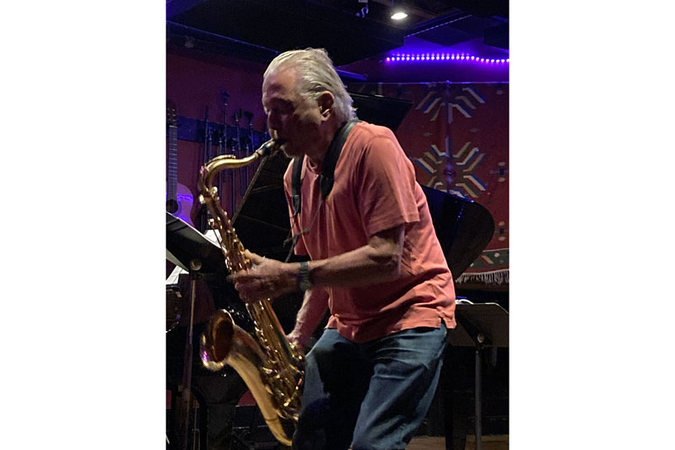
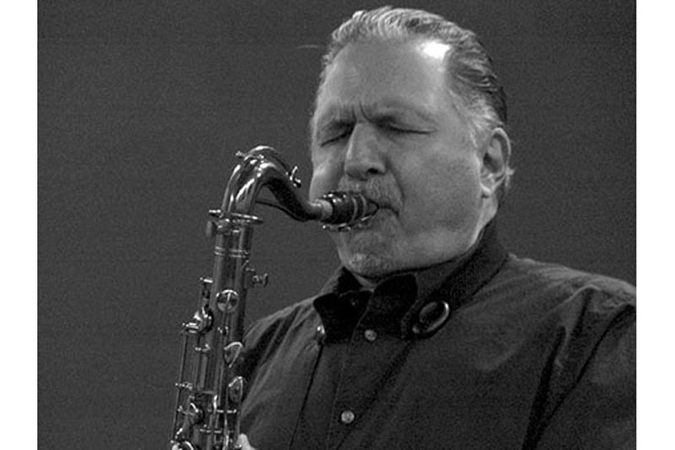
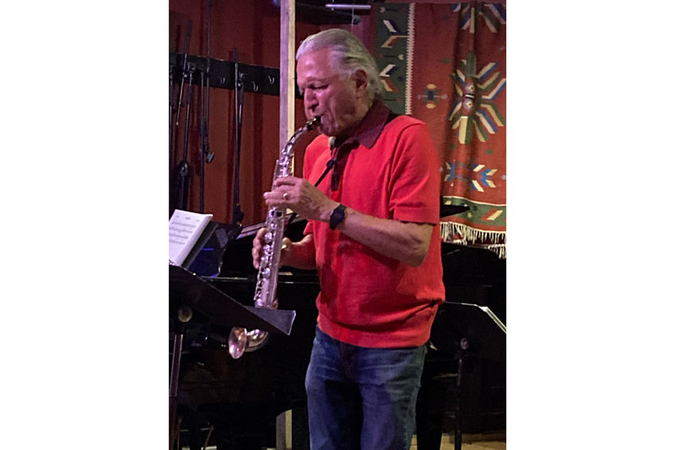

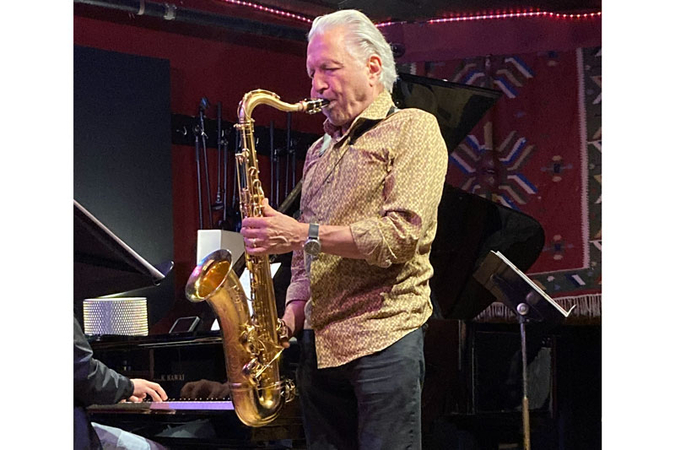
Jerry Bergonzi: Well, you have to do something with your mind, you know, and you have to focus, and I’ve put a lot of focus on music. Both playing music, writing music and the sound and articulation I get. And, you know, people ask me, how do you learn how to play? And I would say, listen, listen, listen, listen. I get ideas from all the people that I listen to and try to make them my own. I’m happy to hear you say that I don’t repeat myself, because to me, I do repeat myself, but I always think that our language is finite, and the reason we like the people we like, you know, like Coltrane, Wayne Shorter, Joe Henderson, Sonny Rollins, Dexter, is because their language is finite. If it was infinite, we might not even like it. It would sound like no personality or something, but you know, I think let a choice be made. Whatever your choices are, what you listen to, what you practice, it all comes out in your playing, and of course, we’re just trying to be in the moment, and play things that inspire us. And I love this quote, “change is the only game in town”. So, people say, “oh man, I really love the way you used to play in the Brubeck recordings”, or “I love those organ records that you made. How come you don’t sound like that?” Because if you go to the store and buy a new shirt, and say, man, I like this shirt, after a while, you’re tired of this shirt, you want another shirt, so you’re constantly changing.
Gustavo Agatiello: You were born and raised in Boston. What were your early years like in the Boston scene? I know you were surrounded by many excellent musicians, like Miles Donahue and others. Could you tell me a bit about those days?
Jerry Bergonzi: Miles Donahue? Well, I’ll tell you how that began.
I was in 10th grade, in high school. Miles Donahue and I grew up in Watertown and his whole family worked during the day, including him, in the summer. And my father worked for the post office, but he worked at night, so he slept during the day. So, I would go to Miles Donahue’s place and practice for 8 hours every day. And nobody was home. So, they said, “yeah, come practice here”. So, then I’d go home, eat dinner, and probably practice even more, you know?
Gustavo Agatiello: Wow!
Jerry Bergonzi: So, we became good friends. His father was a trumpet player, Babe Donahue, and Miles came by to my place once with records of Miles Davis with Coltrane, a Sonny Rollins record, an Art Blakey record with Wayne Shorter and Lee Morgan. So that’s how I got hooked. In the 8th grade, you know?
Gustavo Agatiello: Yeah, beautiful! And who were your first teachers? Did you know Joe Viola, Herb Pomeroy, or John LaPorta?
Jerry Bergonzi: Yes, I was in John LaPorta’s youth band for 2 years, 11th and 12th grade, and yeah, and oh man, that was such a great experience. The Greater Boston Youth Band, and John would tell you like it is, you know? One time he stopped the band and said, “you’re moonbagging, you’re moonbagging!”. I said, what’s… what’s moonbagging? You know, I’m just going crazy, not making the changes, you know? Because I was listening to later Coltrane things and going wild, you know? Yeah. So, man, when he told me that, I said, I’m really gonna learn how to play changes, you know? That was when I was in the 11th grade. You know, and of course, I was playing changes, but he wanted me to get on it. And then, of course, I couldn’t afford to go to school at Berklee, so I went to Lowell State Teachers College, where I met Charlie Banacos. Miles Donahue went to school there, Nick Goumas and Jack Diefendorf who was from Lowell, and these were players that I played with. But then I stopped going to Lowell and went to Berklee for a year. I lost my student deferment, and they wanted to draft me to go to Vietnam, but fortunately I flunked my hearing test. On purpose, I was really good at it!
And I started studying with Joe Viola, at Berklee, and he was great!
Then I went back to Lowell, because I couldn’t afford Berklee, you know. We didn’t have any money in my family and they wouldn’t give me a penny for any scholarships.
Gustavo Agatiello: So, who did you have a longer, or a stronger musical relationship with of these musicians at Lowell State?
Jerry Bergonzi: Charlie Banacos. We would practice every day together. He had a house in Dracut, which was next to Lowell and I had an apartment in Lowell. And he’d play drums, I’d play tenor, he’d play piano, I’d play tenor, I’d play drums, he’d play piano, you know, it was just fun. We’d get so exhausted, we’d fall asleep on the floor, you know, from playing all day.
And then, I got a gig with Charlie at The Shanty in Derry, New Hampshire. I was playing bass, electric bass, 4 nights a week, or something like that. And then I got a gig with Miles Donahue, playing 6 nights a week at The Holiday Inn in Saugus, right above Boston.
Gustavo Agatiello: Were you playing tenor or bass?
Jerry Bergonzi: Just bass. I mean, I was practicing tenor, but I only played bass on the gig.
And then I would go to have these sessions in Roxbury with Tom Marx, Zeppo Marx’s son, one of the Marx brothers. Abercrombie would play, Gene Perla sometimes, Jan Hammer was there one day. Harvey S would be there before he moved to New York. You know, we’d play, and yeah, it was just one big learning experience, you know?
Gustavo Agatiello: Yeah, amazing.
Jerry Bergonzi: I moved to New York in October of 1972. I moved in with Harvey S. And, of course, he was working all the time playing bass. He’s such a great bass player. So, people would say, “hey, Harvey, can you do this gig?” He’d say, “yeah, you need a tenor player?” He tried to get me work. And he did. He got me this gig at the Mercer Arts Center, which was on Mercer Street in Manhattan. We played there every weekend, till the roof actually did cave in, it collapsed! So, we didn’t do that gig anymore, but I was living in New York City, doing sessions every day, in 1973, 74, 75, when I first had my loft on 6th Avenue, and then moved around the corner on 28th Street. Mike Brecker would play, or Bob Berg, Bob Mintzer, Scofield. And then Joe Lovano came to town with Billy Drews and Steve Slagle. They’d come by and play. Yeah, it was just like one big playing feast.
Gustavo Agatiello: Amazing. It must have been incredible.
Jerry Bergonzi: Right.
Gustavo Agatiello: Was this around time you began to codify all the material that later went into your seven books? [Melodic Structures, Pentatonics, The Jazz Line, Thesaurus of Intervallic Melodies, Melodic Rhythms, Developing a Jazz Language and Hexatonics].
Jerry Bergonzi: Right. Those were subjects I was teaching, and they’re not in any chronological order. I used to have this one student, that said “man, you gotta put this in a book, this is great stuff”. So, I did. And my wife, who has a better understanding of the English language helped me organize my thoughts and get them all out there.
Gustavo Agatiello: I’m curious as to how the process was. Was that part of your practice, how you started conceiving your language, music, and how you started organizing it? Did you do it initially for yourself?
Jerry Bergonzi: That’s a great question.
First of all, when it came to learning, nobody taught jazz when I was growing up.
You know, they said, “yeah, just listen to records, learn tunes”. So, if somebody knew something, they sure as hell weren’t gonna tell you about it, you know?
So, I would gather information. My friends would tell me somethings. But I just thought, man, how can I get better? So, all these books are things that I thought myself, but I developed them even more teaching. Because I said, I know this stuff, but how can I break it down for a student so they could get it? And that’s how I codified it so that I could put it in digestible increments so somebody could get a handle on it. I kind of did it step-by-step so a student could grasp it.
Gustavo Agatiello: So, your own process was a little looser than that.
Jerry Bergonzi: Yes.
Gustavo Agatiello: So, more trial and error, and listening.
Geraldine Bergonzi: Yes, listening.
Gustavo Agatiello: Did you go through a time where you transcribed a lot?
Jerry Bergonzi: Absolutely. I played along with records a lot, and I’d pick up a lot, but then with some records I just couldn’t do it. And I remember putting it on my reel-to-reel and going half speed. It’d go down an octave, you know, because they didn’t have what they have today. And I would transcribe Coltrane solos, Wayne Shorter solos, McCoy, you know, all different people, Sonny Rollins. And then I got pretty good at it. I used to have this student come take a lesson. His name was Bill Sullivan. He’d bring me a solo, and I’d transcribe a solo while he was there. You know, I did practically a solo every week for him, but they were simple solos, you know, Louis Armstrong, some Sonny Rollins solos.
Gustavo Agatiello: And you would write them down?
Jerry Bergonzi: Yes, I would write them down.
Gustavo Agatiello: Okay, so writing them down was part of the process when you transcribed?
Jerry Bergonzi: Particularly if I couldn’t grasp it. Then I would write it down, and I realized, by writing it down, I could not only get to play it, but I could analyze it. So, wow, he’s coming on the “and of 3” a lot, you know, this sort of thing.
Gustavo Agatiello: Yeah, that’s what I mean, because in all of your educational materials, your videos and the books, I realize there’s a lot of attention to detail in terms of time, time feel, and of course, rhythm. All these variations that you do to melodic or harmonic material, and so I wonder, where does that come from? You know, maybe from the process of transcribing, seeing something written down and realizing what a phrase or melodic line contains, how it relates to the harmony, where it comes in, is it anticipated, delayed, you know…
Jerry Bergonzi: All of that stuff, all of that. I remember having arranging lessons from Steve Gould at Berklee when I was in high school, and I also had composition lessons with a person who taught at Boston Conservatory, Dr. Avram David. Kind of like modern classical music, you know? So, a lot of that just intrigues me, and I’m listening to Coltrane and all the stuff he plays, saying, man, how can I even begin to appreciate some of this music that he’s playing. What is it? And when I listen to Herbie Hancock with Miles Davis and Wayne, the stuff that they do, the harmonic language they have just spell bounds me. So, I try to get a handle on it, and make it my own, and do something with it. And I realize that everybody has their own approach. Everybody has their own stuff. And that’s why it takes you a while, I think, to believe in yourself. And, yeah, if you breathe, you’re valid. So, I just said, yeah, I’m gonna write tunes and play them, and try this, try that. So, you get to the point where you’ll try anything, you know?
Gustavo Agatiello: Yeah. I heard you play piano a lot during a few years at the Lilypad because there was no pianist. I wonder how important the piano is to you in your own development?
Jerry Bergonzi: It’s very important, yep. I mean, I think about saxophone players, or trumpet players who play very little piano and I think of ones who play piano and I hear a difference, you know? You know, I used to visualize on piano all the time. And then I realized, I’m a saxophone player, so I started seeing the saxophone like a piano, all the notes down at the same time. Stacked up like a piano. So, playing piano helps me like that, it helps you writing tunes, voicings, ear training. I went to a psychic once and she said I was a piano player in another life.
I believe it, because in some ways, you know…
Gustavo Agatiello: Yeah, I mean, I love your approach and sense of harmony at the piano. It’s obvious that it’s fundamental to your playing. How was your process learning piano? Did you have lessons?
Jerry Bergonzi: Well, my mother bought a piano for my sister. She played a little, so there was always a piano in my house. So, you know, you practice the saxophone for 3 hours, and you go, I need a break. I’d sit at the piano and play just diatonic 7th chords, and so on, and after years, especially through teaching and having to accompany people, I got pretty good at it. I had three piano lessons with Madame Chaloff, Serge Chaloff’s mother, and she had me play a Bach invention. Playing one hand on the piano and playing the other hand in the air, and saying what the fingerings are out loud, and singing one hand while I was playing the other.
Gustavo Agatiello: Oh, wow!
Jerry Bergonzi: So, it taught me how to visualize. But, yeah, basically my piano playing is self-taught, though. And part of me would like to spend a lot more time with it. I don’t know, if I had a gig a couple of nights a week, I’d really get better at it. But yeah, it fascinates me.
Gustavo Agatiello: So, you’re saying that when you play tenor, you visualize groups of notes.
Jerry Bergonzi: Yeah, I can see groups of notes as opposed to one note at a time.
Gustavo Agatiello: Right, and that, you feel comes from the piano.
Jerry Bergonzi: Yeah, definitely helps. I mean, playing saxophone, of course, but playing piano definitely helps me see the whole voicing that I’m playing with. So, that’s the other thing. We don’t play on chords. We play on voicings of chords.
Gustavo Agatiello: Right, I heard that from you before.
Jerry Bergonzi: So, I’m thinking about the voicing of the chord when I’m playing. Because I could play voicings that wouldn’t be inspiring at all, basic voicings, but when I’m thinking about certain voicings, it’s inspiring to me.
Gustavo Agatiello: Listening to you week after week, I notice how different you play with and without piano accompaniment. Even with different pianists accompanying you.
Jerry Bergonzi: You know, it’s a very interesting thing. I know Phil Grenadier loved playing without piano, but he liked the way I played piano behind him. For me, I mean, I could play trio, or piano less every week, but all the music I grew up listening to, or most of it has piano in it, and I love it. You know?
Gustavo Agatiello: Yeah. What do you look for in a piano player?
Jerry Bergonzi: Well, that’s a great question, and I always tell people: do you want my zen answer? My zen answer is, I want a piano player that makes me sound good. I want a bass player that makes me sound good, a drummer that makes me sound good. And that means you have listened to the same music that I have listened to. And you know what I’m looking for, and you’re willing to give it to me. As opposed to, oh man, he’s playing a solo, I’m gonna play another solo with him. You know, it’s about accompaniment. Like, if the piano player starts soloing, I don’t play a solo behind them. I mean, sometimes I’ll play a couple of notes here and there, but you know, I like a person who knows how to accompany somebody and lead you in a good way. Adam Nussbaum says “a good accompanist is like a seeing-eye dog. They know how to lead you, but they never get in your way”.
Gustavo Agatiello: Right. I can think of, for instance, “Lineage” with Mulgrew Miller on piano.
Jerry Bergonzi: Yep, okay, so, Mulgrew Miller gave a master class at New England Conservatory, and he said, “you know, I solo okay, I’m alright, but I’m never out of work, because I studied how to comp. I can comp like Bill Evans, like McCoy Tyner, like Herbie Hancock, like Chick Corea, like Winton Kelly”. And he named all the great piano players. He said, “when I hear somebody play, I know exactly what they want, and I give it to them”.
Gustavo Agatiello: Right, and that’s a great example of what you just said. Yeah, that’s what I hear in that recording. He’s just giving you everything you need.
Jerry Bergonzi: Everything!
Gustavo Agatiello: How did that record date come about?
Jerry Bergonzi: I got a National Endowment grant to do a recording and I hired Mulgrew, Dave Santoro and Adam Nussbaum, and we played at this church in Back Bay. I forget the name of the church. We thought it was terrible, because it was just one big echo chamber. We thought, oh man, what a terrible gig. But Peter Kontrimas recorded us, and you can’t hear the echo on the tape. I remember I was drinking cognac in the back, and saying “this thing’s gonna be terrible anyway”. We did it, and it came out good!.
Gustavo Agatiello: Oh, it’s amazing, man!
Jerry Bergonzi: And people talk about it, you know, and Adam said he’s never even listened to it. And I only listened to it when it came out, you know? And we had some other tracks, I don’t know where they went, you know?
Gustavo Agatiello: Oh, I need to get my hands on those!
Are there any particular recordings of yours that inspire you? Certain musical situations?.
Jerry Bergonzi: You know, I don’t look back, I just look forward. I try to put myself in situations like, I just did this gig with Sean Pentland and, man, I had to keep my eyes glued to the music all the time, because it was music that I wasn’t accustomed to playing. It’s through composed, 9-bar phrases, 17-bar phrases, where any chord goes anywhere, you know. But it came out really cool.
Gustavo Agatiello: Let’s see, where do I want to go next?
Jerry Bergonzi: Oh, I gotta tell you another story. My mother got my sister a piano. My uncle, who lived upstairs [not my blood uncle, he was my step-uncle, because my mother was divorced and remarried] played bass, guitar, trombone, great musician. She bought a bass from him for my brother for $150 at the time. And he stopped playing after weeks. That’s how I learned how to play bass. There was a bass in the house. So, piano and bass…
Gustavo Agatiello: Wow! you seem to have picked up all these instruments pretty much naturally.
Jerry Bergonzi: Yeah, through listening and playing.
Gustavo Agatiello: Were you listening really intensely at that point?
Jerry Bergonzi: Oh, yeah. Well, at the time, I listened for a reason. I wanted to learn how to play this music. I can remember, you know, Miles Davis’ records would come out and I’d try to transcribe the tune and try to get the voicings of Herbie Hancock and those sorts of things.
I would get to playing this gig on bass, and I’d come home to my apartment in Lowell and I’d put an LP on, and I’d listen to the LP, and I would just listen to the bass. Then I just listened to the piano. I put the same side on, just the piano, then just the drums, then the whole quartet. And I could isolate instruments and just hear that, trying to concentrate.
Gustavo Agatiello: That’s really deep listening.
Jerry Bergonzi: Yeah, deep listening. Herb Pomeroy used to say [I had Herb Pomeroy when I went that year to Berklee] that it took him till he was about 40 to hear the whole band, you know?
Gustavo Agatiello: So, nowadays, how’s your practicing routine? How is it that you enjoy doing that? I ask you this because, as you know, I transcribe you, and I’ve come up to you many times to pick your brain about things I hear in your playing. For example, once it was clear to me that you were playing groups of 5 notes, and when I showed it to you went “that’s exactly what it is. I practice playing 5 over 2 or 5 over 4” and so on. And I thought to myself, that’s why it’s so clear, you know?
Jerry Bergonzi: Many years ago I remember making myself these cassette tapes. I’d play piano, medium tempo, and I’d play two fives going down whole steps. I did it for 15 minutes. Then I did up a half step, so I’d get to the other 6 keys for 15 minutes. So, for 30 minutes I said, I’m gonna play quintuplets the whole time. When I first started, oh my… nothing lined up, you know? Because quintuplets and septuplets are both dissonant rhythms. So, I got better and better at it, and did septuplets, and then I did nines. And now I just think of playing rubato, and then the gears come through and I don’t even know I’m doing it, you know? [playing groups five, seven or nine notes].
Gustavo Agatiello: Hmm. So nowadays, are you one of these people who have a regimented way of practicing?
Jerry Bergonzi: I used to. Lately, in the past couple years – and I’m gonna stop doing this, because I want to start practicing again – I don’t practice lines or anything like that. I was practicing articulation, time and sound.
Gustavo Agatiello: So, in your order of priorities, what would you say comes first?
Jerry Bergonzi: I think of the Creator, Mother-Father-God, or Mother-Father-Spirit. I think Father is “time” and “sound” is Mother. They go together. Inseparable. But, you could have a great sound and if you don’t have a great time, it won’t work. But you could have a mediocre sound, and if you have a great time, it sounds great. “Time”, that would be number one.
Gustavo Agatiello: So, then “sound”?
Jerry Bergonzi: Yes, and then how you “articulate” the “time”. And your imagination, your lines. Actually, your sound, because we’re all looking for our sound, it’s a search for your soul. Who am I? What do I want to sound like? What qualities, what overtones do I want to hear ring? What resistance do I want to have? How centered is it? How spread is the sound? How much treble? How much bass? How warm is it? How round? All of those things. So, you’re searching for who you are. You want who you are to come out, and no matter what you do, only you come out anyway. But you want the best representation of who you are to come out. That’s why you gotta give it up to everybody. Everybody’s got something to say. You’re listening to their soul, whether it’s on an advanced level or not, you know?
Gustavo Agatiello: And you said you want to get back to practicing?
Jerry Bergonzi: Yeah, you know, obviously, I’ll hear students play, and I can hear how their technique is amazing, you know? And I don’t practice technique, you know?
Gustavo Agatiello: I know you have interests such as numerology and astrology and that seems to be an important part of how you conceive music, too.
Jerry Bergonzi: Yes, you know, at an early age, I used to go to these meditations at Madame Chaloff’s house. They were very metaphysical. And then, I was living alone, and this young lady who I was going out with said, “I’m going to an astrology class Tuesday, you want to come?” I said, no, not really. But I used to meditate, and the room would be moving around, you know? Then Tuesday came around, and I went to the class with her, because I had nothing better to do, and I fell in love with it immediately. So, the planets are the energies that everybody has. Mars is aggressive, and you know, in the sign Cancer, which is a water sign, it doesn’t function well, and the sign Aries, it’s the ruler, you know? Capricorn is a hard worker. So, there’s all these energies and where they are, and I can see them happening in music.
Gustavo Agatiello: Yeah, beautiful. Jerry, thanks so much for sharing your time and wisdom.
Jerry Bergonzi: Thank you, my friend.
Oh! The only other thing I wanted to say is that when you’re young you don’t realize you had the best saxophone teacher on the planet, Joe Viola! John LaPorta, too, but Joe Viola would have the patience and the kindness. He would play piano for me, and I’d say, Joe, what’s a flat 9, you know? He was amazing! But when you’re that young, you don’t have anything to compare it with. I had the greatest saxophone teacher on the planet.
Gustavo Agatiello: And he was a very important figure for many here in Boston, right?
Jerry Bergonzi: Absolutely! George Garzone, Joe Lovano…
Gustavo Agatiello: I can hear a common denominator in all of you.
Jerry Bergonzi: Yes!
Gustavo Agatiello: As if there’s something from very early on that binds you together.
Jerry Bergonzi: That’s olive oil. [laughs] But I wanted to get that in about Joe. Thank you!
Gustavo Agatiello: Thank you, Jerry. See you tomorrow at the Lilypad.
Jerry Bergonzi: Okay, ciao ciao!
For Bergonzi, it is all about the music. Accolades and glory are far from his mind. In a world that rarely recognizes such dedication, he has carved out a life in Boston, where he can compose music, play a weekly gig with his quintet and teach at New England Conservatory with no curriculum restrictions. He travels about 130 days a year performing. All this he balances with a rich family life: He and his wife, the accomplished pianist Jeri DiMarco Bergonzi, have two children.
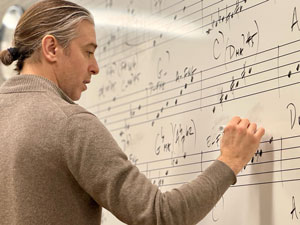 Gustavo Agatiello is a vibraphone player based in Boston and an Associate Professor at Berklee College of Music. He has collaborated with Ed Saindon in the production and publishing of his books, The Complete Guide to Improvisation, Volumes 1-4; Voicing Concepts for the Jazz Vibist; 50 Etudes for the Jazz Vibist; Pedaling & Dampening Applications for the Vibraphone; Applications, Concepts & Techniques for Solo Vibraphone, and coming soon Lessons and Clinics with Gary Burton.
https://www.instagram.com/gustavo_agatiello/
https://www.youtube.com/@GustavoAgatiello
allthingsimprovisation.blogspot.com/
allthingsvibraphone.blogspot.com/