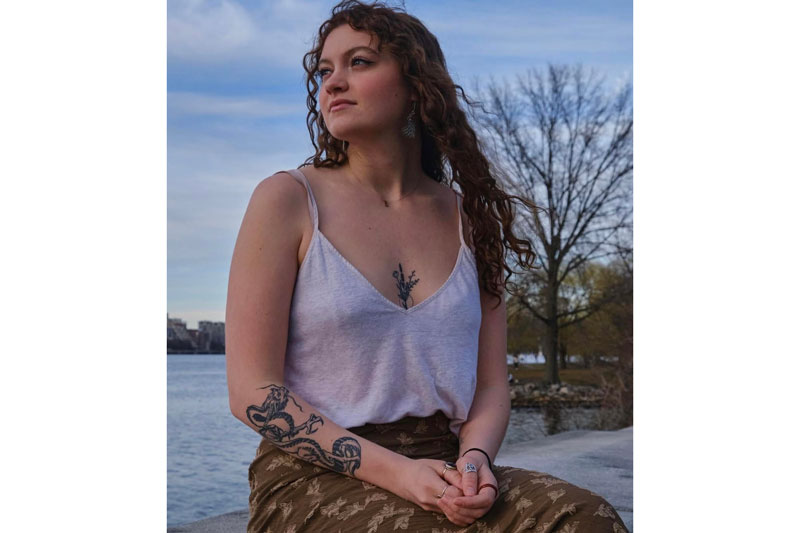
In high school, Sophie knew two things: she wanted to be a social worker, and she loved music. When she found out about Berklee’s Music Therapy program, she described it as a “Goldilocks situation”—just right. “Art accesses things in people that nothing else really can. I wanted to be a part of spreading that power.” She attended Berklee from 2020 to 2024. In 2025, she completed her internship and was awarded her Bachelor’s in music therapy.
During her coursework at Berklee, Sophie completed 200 hours of music therapy clinicals. Due to COVID, some were in person, and others were via telehealth. Although this provided insight into the state of modern medical practice, Sophie certainly prefers in-person work with an emphasis on face-to-face human connection. She participated in guitar and piano classes that focused on musical cueing for stimulating cognitive functions. Sophie also studied in depth the four methods of music therapy– receptive, recreative, improvisational, and compositional– while applying them to different populations. While reflecting on her studies, she noted, “The classes were informative but also emotional. The music therapy major is a close-knit, supportive community thanks to attentive professors like Dr. Low and Brian Jantz.”
After graduation, Sophie dealt with burnout and the stress of securing an internship. She took time to be in nature with her dog, Rosie—the two things she loves the most. She drove 2,500 miles out of Boston and landed in Escalante, Utah: population 800. There, she spent a year working, camping, and gigging. At 21, she was one of the youngest in her new close-knit community. She performed classics with a band at the local restaurant called The Outfitters. “Our love of music bridged generational gaps; everyone was in it, feeling great and connected.”
Deciding what kind of internship she wanted was a challenge, as the options ranged from hospice to child therapy. Ultimately, she chose adult mental health, a path that hits close to home for her immediate family. “I get to spend every day helping a community by doing what I love in a field that is very personal to me.”—a rare and beautiful distinction from many recent college graduates.
In December of 2024, Sophie moved to Phoenix, Arizona, where she began her 6-month internship at Arizona State Hospital, a court-ordered psychiatric facility. Before starting, she didn’t know what to expect. She mentioned dealing with imposter syndrome and feeling intimidated by the verbal processing (counseling) aspect of the job. Working 40 hours a week, unpaid, is also a massive challenge. However, through connecting with her patients, their needs and her skills came naturally to her, and the internship proved very rewarding. Sophie mainly worked in the civil campus on their rehabilitation team as a music therapist. Her focus was on therapeutic social interventions for social skills, anger management, and stress through didactic therapy (coping mechanisms).
Sophie was hired by Arizona State Hospital after her internship and is currently working full-time in their forensic unit. She will soon be pursuing her masters in social work to further her knowledge on clinical counseling. As a musician, Sophie writes and shares online original modern folk songs. It is evident that she pours raw emotion into her lyrics and melodies. She describes her writing as “a way to sort things out” that she didn’t even know she was feeling—which is exactly what she provides for others in her work.
I want to take a moment to thank Sophie for sharing her selfless and inspiring journey.
With that, I’ll leave with a very important final statement from Sophie:
“The mental health field is one that you will constantly have to advocate for. It is not taken seriously enough. You know the difference that you’re making. Always remember to give yourself grace. There is nothing unserious about helping people.”

Berklee Alumni Column Introduction
Joely Cromack-Kluko

Berklee Alumni Column #6: Andrew L. Lucas
Joely Cromack-Kluko

Berklee Alumni Column #5: Paulina Romano
Joely Cromack-Kluko

Berklee Alumni Column #4: Natalie Dodge
Joely Cromack-Kluko

Berklee Alumni Column #3: John Keyes
Joely Cromack-Kluko

Berklee Alumni Column #2: Angie Polizzi
Joely Cromack-Kluko