What is aesthetics? For my students at Berklee, I considered it to be: “Those qualities that make art Art,” qualities which are variable (more below) but, in one way or another are unmistakably associated with those creative endeavors we intuitively recognize as a unique and enriching experience, requiring our full engagement. The experience may be entertaining, but it goes beyond pure entertainment. A complementary definition is what Arthur C. Danto claims in his book, What Art Is: “By aesthetics I shall mean: the way things show themselves, together with the reasons for preferring one way of showing itself to another.” Both definitions imply a human creator and are not concerned with the undeniably satisfying aesthetic effects produced in nature or the natural objects one encounters daily, as a strikingly handsome individual. It is not simply a matter of “beauty in the eye of the beholder” but requires translation by an artist into artistic matter.
So, aesthetics in this sense is not examining the abstract philosophical question, “what is beauty?” Rather, it is a most practical question for the artist. Poet Robert Frost in 1939 wrote in his preface to his Collected Poems about “The Figure the Poem Makes”: “Abstraction is an old story with philosophers, but it has been like a new toy in the hands of the artists of our day.” Among the most critical, practical elements of the artist are Form and Spontaneity. These correspond to Nietzsche’s concept of the ideal of classical Greek tragedy, a balance between Apollonian form and Dionysian ecstasy. Poetry and music are particularly evident examples of this combination, one that is required and present in all the arts. The audience must experience some recognizable form that contains the free and individual reign of the artist’s spontaneous and imaginative world. Yet the equation of form and spontaneity need not be equivalent. In contemporary art, I believe that it is often the intuitive genius of the artist that allows spontaneity to evolve into form rather than form being the mold into which spontaneity is encased.
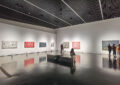
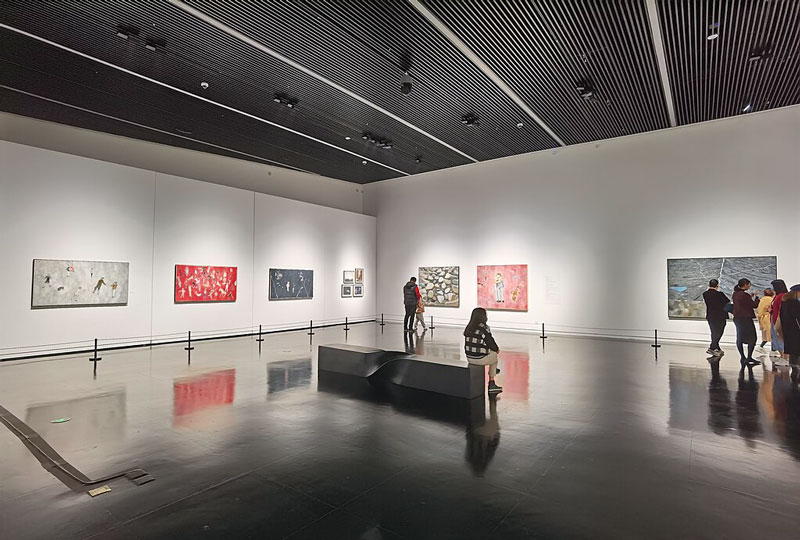
Form includes not only the structure of the art but also venue, be it museum, theater, or simply the frame around a painting. This, along with spontaneous elements, are “qualities” we associate with what we recognize as art. Over the years my students have come up with fairly consistent lists of some major qualities they associate with art: context (as museum or theater or printed novel); a title; intentionality (artistic expression and spirit); surprise (unexpected combinations, twists); originality (“relevance,” – inspiring other artists); time-less (not tied to time of its creation, but also conventional clock time stops when one engaged in the artwork, music, film, painting, etc.); organic (integral, whole); self-referential (calls attention to itself); “embodied meaning” (a term from Arthur Danto, equivalent to Kant’s “aesthetic idea”); “useless” (Oscar Wilde claims this; in that it is devoid of physical necessity or practical use). Not all art possesses all these qualities, but rather some combination of these are apparent in most creations we call art. Two qualities, however that seem universal are those of repetition and resemblance. I speak here both of an intrinsic element in the art itself, as well as the experience of it.
Elaine Scary claims, “Beauty brings copies of itself into being” (Of Beauty and Being Just). These “copies” are more precisely “translations” in one medium or another of an aesthetic entity, and this significantly includes the influence of an artist’s work on the artwork of others, what T.S. Eliot describes in “Tradition and the Individual Talent.” However, Eliot insists that even shunning an art’s tradition seeking “novelty” is preferable to slavish, “blind or timid adherence to its successes.” And to quote Oscar Wilde: “The fact is, the public make use of the classics of a country as a means of checking the progress of Art. They degrade the classics into authorities. They use them as bludgeons for preventing the free expression of Beauty in new forms” (The Soul of Man Under Socialism). Modern critics have spoken to this inhibiting cultural influence (for example, see Edward Said). Repetition vitiates art and the artist, but artists provide us with an invitation to their art through the forms we recognize, repetition within a work of art itself (as in music) or in reference to or paying tribute (in their own voice and style) to the influence of past art and artists. And as Eliot says, “No poet, no artist, has his complete meaning alone.”
Poet Wallace Stevens contributes what to me is a more apt word, and that is “resemblances”: “The study of the activity of resemblance is an approach to the understanding of poetry. Poetry is a satisfying of the desire for resemblance. . . . Its singularity is that in the act of satisfying the desire for resemblance it touches the sense of reality, it enhances the sense of reality, heightens it, intensifies it” The Necessary Angel: Essays of Reality and the Imagination). Poet Octavio Paz affirms that, “the poem is a shell that echoes the music of the world, and meters and rhymes are merely correspondences, echoes, of the universal harmony” (Octavio Paz, The Bow and the Lyre, 1973).
While Stevens speaks of resemblances to what is external to the art form, it is equally true of resemblances between art and artists—the transformation “heightens” our sense of the tradition and the present art simultaneously. It is not a “copy,” not mere filiation but affiliation ( to borrow words from Edward Said in The World, the Text, and the Critic, 1983) – not simply parent-child but instead connections to larger contexts. “Appropriation” in this sense is not a negative term but rather a complement and new creative invention – aesthetic progress in the sense not of perfecting but of adopting to the present historical and cultural moment. Form provides a critical source of “resemblance” for an audience in any art medium while spontaneity provides the individual and the new, the “original.”
In the reception of art, the desire for repetition, to re-experience a particular art creation, speaks to some quality which provides more than entertainment alone. And in reception we are being asked to be good spectators or listeners – not to interrupt the experience till the whole image, in whatever genre or medium, is completed. This, I tell students requires putting aside any initial search for a “meaning” in order to experience the whole. This is most beautifully expressed in Wallace Stevens’ poem, “Man Carrying Thing.”
Almost successfully. Illustration:
A brune figure in winter evening resists
Identity. The thing he carries resists
The most necessitous sense. Accept them, then,
As secondary (parts not quite perceived
Of the obvious whole, uncertain particles
Of the certain solid, the primary free from doubt,
Things floating like the first hundred flakes of snow
Out of a storm we must endure all night,
Out of a storm of secondary things),
A horror of thoughts that suddenly are real.
We must endure our thoughts all night, until
The bright obvious stands motionless in cold.
It is the same for all the art forms, to hear the whole song or symphony, to see the whole painting, to complete the novel or film, to absorb it as an aesthetic experience whose “meaning” is its aesthetic satisfaction. William Carlos Williams lectured students at the University of California in LA: “The arts are sensual in their intention to impress. Let the poem come to you. Put all you have in trying to hear the poem, hear it. Otherwise, how can you know it is a poem? Later, perhaps, if you are superlatively able and perspicacious you may discover what it ‘means’ – or something like that” (The Autobiography of William Carlos Williams, 1948).
Through readings of Walter Pater, The Renaissance, and Oscar Wilde The Critic as Artist, the poetry of T.S. Eliot, William Carlos Williams, and Wallace Stevens (as well as more contemporary poets), and through a trip to the MFA and a viewing of Antonioni’s challenging 1966 classic film, Blow-Up, my students over the years left the semester, to my great delight, liberated to enjoy art for art’s sake. They got it!
Link for purchase of book
Hillocks, CC BY-SA 4.0