| Subcribe via RSS

Be kind to old, forgotten clothes

September 18th, 2009 | No Comments | Posted in Student Editors' Favorites

by Michael Hazani


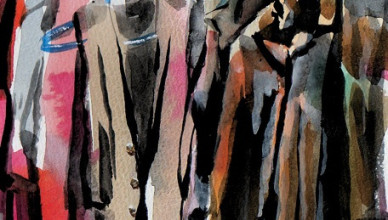
Be kind to old, forgotten clothes

Of which you’re eager to dispose,

To ancient woolen sweaters which

(Though maybe once have found their niche)

Appear like relics from the past

That someone foolishly miscast

As garments you might want to wear.


Be kind to shirts you’d like to spare,

To trousers torn beyond repair,

And corduroys that have served you well

As blankets in some cheap motel -

Pray, don’t dismiss them without thought,

In some polluted parking lot

Trampled, torn, and poorly wrapped -


Be kind to every single flap

That’s hidden in your drawers, unmapped

For you may end up one of those

Who (not unlike those ancient clothes,)

Astounded, find that they’ve been scrapped

Trampled, torn, and poorly wrapped.


Michael Hazani currently studies at Berklee.


Tags:

Birding for Berkleeites: The Fenway Victory Gardens

September 18th, 2009 | No Comments | Posted in General Nonfiction

by Fred Bouchard


… the wings alive!–excite the marbled snows…

A fugue of wings darts down through the still air,

A dancing passage of staccato notes,

Now up, now down, and glancing everywhere,

Glissandos of black caps and neat white throats.

Here come the chickadees!

                                              —from A Fugue of Wings, May Sarton (1961)

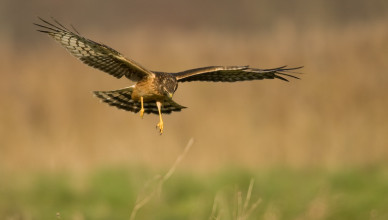
“Why watch buurds?” ask skeptical, even dismissive, acquaintances.

“I’ll tell you why,” I once said perkily, then recited a long list of reasons. Those reasons — written down, expanded, revised – were then lost, so I’m writing them again. They may have changed some, as I have over 30 years at America’s second most popular outdoor hobby – birdwatching, casually called ‘birding’.

Here’s what birding can do for you.

Bring you closer to a beautiful natural family. Birds are amazing: they’ve inspired and awed mankind in song and saga since dawn-age. Birds not only fly, but hover, wheel, soar, dive, and migrate incredible distances. (Some even walk funny). Many have: fascinating, complex – even mysterious and confusing — songs and calls; extraordinarily resilient adaptive powers for survival; plumage that changes seasonally.

Get you outdoors. Plenty of exercise hiking the backroads, woods, mountains, and beaches in pursuit of these often elusive winged critters.

Sharpen your eyes. Learning fine details of bird observation (field marks, habits, and movements) are critical to satisfactory (ie, accurate) bird identification.

Retune your ears. To become good at birding, you’ll eventually learn the songs (and calls and other communicative noises) made by the 300+ species found in the Bay State each year. (Make that 800 nationally, and 10,000 worldwide. Gasp!)

Make you curious. Not just about the little things you see and hear (and take for granted) everyday, but in a larger sense. Read on.

Interests you in related studies (botany, zoology, geography, natural history.) It’s not a stretch to be curious about which berries a Cedar Waxwing prefers, the favored nesting trees of Wood Ducks, why some Canada Geese migrate and some do not; why Eastern US gets one hummingbird and the West gets 20!

Improve your map-reading, giving and getting accurate directions. Finding a house on a street is one thing, but finding a specific 5″ warbler that’s been located in a 10-acre park will take require serious up-grading and fine-tuning of your homing skills. MapQuest will take you just so far (although GPS is now being utilized by extremely efficient birders in Europe). Even looking at a landscape or a single tree together with others, you need skills to point onlookers to a very specific spot. (Pointing and saying ‘up there!’ won’t usually do the trick.)

Teach ecology and habitat preservation. Everyone’s talking the talk of ‘green revolution’ these days: hybrid cars, wind farms, compact fluorescents, canvas grocery bags, lights out, you name it.  But who walks the walk? Why, birders, of course, since before it became hip! 

Provide amusement for a minute or all day. You can bird actively during a ten-minute stroll or an all-day hike.

Give you a hobby that’s portable and cheap. At least at first. All you need to start is a good field-guide (Sibley’s or Peterson’s, $25) and decent binoculars (make inquiries, spend $250 up). Later on, more field guides, better binos, and a telescope. Much later on, plane tickets to exotic places for expensive and exhausting field trips. But not yet!

Travel with you world-wide. Pop your binos in your horncase or backpack, read up on The Birds of Thailand or Costa Rica, and you can bird the globe, wide-eyed and digging the scene while the band’s asleep on the bus.

Easy birding can start right outside your dorm or classroom. Herring Gulls overhead. Starlings and Pigeons in the squares. Pearly Mourning Doves cooing and bright-red Cardinals wheet-wheeting in the trees, House Sparrows chirping in the bushes and under your feet outside Starbucks. (A pair of American Kestrels nested in the roof cornice at 11 Haviland Street last year; dunno if they’re back.)

Birding can mix with other activities, like, how about — Red Sox baseball. From April thru (we hope) October, birding right in Fenway Park can offer amusement, especially if the game’s an error-filled teeth-grinder. Last April during a day game I logged from the bleachers: Mourning Doves (strafing the beachball set as they flew back and forth across the bleachers); House Sparrows (copulating on the scoreboard wall); Chimney Swifts (surfing a lull in the NW wind); Grackles and Redwinged Blackbirds (clacking as they migrated overhead); (Rock) Pigeons, Herring Gulls, and a Great Blue Heron soaring overhead, Starlings kibitzing on the light stanchions, the resident Red-tailed Hawk (King of the 400 Club). 

And the birding can be much better in the nearby Victory Gardens before or after spring day games. Stand with your back to the Ted Williams statue outside Gate B, then head (almost) straight across Boylston St. to the Fenway. Between the garden’s numbered rows – despite the hard-working spring gardeners — you may well find cardinals, robins, white-throated sparrows, now-bright goldfinches; maybe a hermit thrush, brown thrasher, Carolina wren, common yellowthroat, or even surprise an explosive American Woodcock. Perched over the river, look for the bull-headed, quick-cackling Belted Kingfisher; seek higher up for Tree Swallows, cruising the skies for flying bugs; or atop the phragmites reeds for the gurgling call of the Red-winged Blackbird.

Other cool birding spots in Boston (check-a da web): the entire Emerald Necklace of connected bodies of water (of which the Victory Gardens and The Muddy River are just one segment), that extends from the Charles River to Jamaica Pond. Chestnut Hill Reservoir. 

In Brookline: Hall’s Pond (behind 1000 Beacon Street); In Cambridge: Mount Auburn Cemetery (on the bus-line a mile from Harvard Square), Danehy Park and Fresh Pond (near Fresh Pond Circle).

Groups you might want to join up with: Brookline Bird Club, Massachusetts Audubon Society. Good birdin’, fellow musicians!


Fred Bouchard is a faculty member in the Liberal Arts Department at Berklee.


Tags:

Kairos by Mateus Starling

September 13th, 2009 | No Comments | Posted in Reviews

A review by Erin Thomas

Kairos, the debut full length from Berklee grad Mateus Starling, is a compelling and innovative artistic achievement for the young guitarist and his band of remarkable musicians. Starling is joined for the first 6 tracks of the album by Chris Cabrera on bass, drummer Pablo Eluchans, and tenor sax player Jesse Scheinin, and finishes off the last two songs backed by bassist Caio Slonzon and drummer Edu Nali. Although the guitarist/composer is the star throughout the album, his band deserves a large amount of credit for adding depth and solidarity to Starling’s ideas. All the material on Kairos was recorded as a live ensemble, for reasons which Starling himself explains best. “My expectation was to capture the interaction of the band on the solos and to have that kind of energy that we hear on most of the old jazz projects,” he says. As a result, Kairos is full of energy and life, and documents a band that knows how to listen to and answer each other while remaining locked into tight grooves.

 The album’s first track, “Exodus,” kicks off with a strong bass line and impressively performed tenor sax solo and melody, and moves into an eerie guitar solo that feels more at home in the genre of experimental rock rather than straight ahead jazz. It’s followed by “Good Moments,” which features Hendrix-style effects put to good use on powerful jazz-rock riffs and an edgy melody. “Jerico,” one of the jazzier tracks, starts off with some quick drum rolls and dives into a racing melody. The song slows into a solo section, including a bass solo by Cabrera that builds up to the final chorus. The album keeps up the quick pulse with “Brazilian Funk,” a tune that delivers exactly what its title promises. The mood changes directions a few tracks later with the beautiful “Pai,” a jazz ballad that begins and ends with a lullaby-like guitar line, supported by smooth tenor sax throughout the piece. The final two cuts, although more stripped-down, highlight Starling’s exquisite tone and note choice. The album’s closer, “Ark,” really stands out as a haunting, slow tempo dirge, and finishes what can only be described as a musical journey with gentle ease.

 Starling’s strengths (and there are many) seem to lie within his ability to write jazz melodies that incorporate his love of the rock guitarists that influenced his playing at a young age, as well as the Brazilian music he was surrounded with growing up in Rio de Janeiro. Just as noteworthy as the melodies, however, are Starling’s solos, played to perfection in each turn he takes. Kairos should and undoubtedly will succeed in establishing Mateus Starling as a young and important force in the world of free jazz and Brazilian rock.   


Erin Thomas currently studies at Berklee.


Tags:

The Bare Bones of Bare All

September 13th, 2009 | No Comments | Posted in FUSION City

The Pike by Alexander Suarez

                                                                                                                   The Pike by Alexander Suarez

by Scott Nanos

It’s three fifteen in the afternoon when I arrive at the photographer’s studio. The entire apartment is one large room. All four walls consist only of brick and black cavities where brick once existed. A lonesome, feeble wood column reluctantly holds up the entire ceiling. It moans in agony as I pace the room, threatening a collapse. The door latch clicks shut with an irreversible finality. I’m trapped.

I peel off my shirt at a glacial pace. My breathing reduces to quick, shallow wheezes. I belatedly realize why most nude models change into robes first. My fingers, shaking like dogs in the rain, move to my shoes. I blink, and both of my useless hands are ensnared in a tangled labyrinth of shoelace. I forcefully shake them free, curse under my breath, and kick my shoes off. They collide hard against the wall. The column groans in pain. My socks, a pair of black cotton pythons, asphyxiate my mousy ankles. They are a relief to uproot.

I’m now face to face with the agonizing affair of taking off my pants. The caterpillars chewing at my stomach have mutated into full-blown butterflies. Cacophonous, imaginary laughter floods my ears. Conceptually (in the realm of art), the human body, regardless of shape or size, is beautiful. But ideals can’t be woven into a safety net. And I’m about to take the plunge.

 My jeans take a nosedive. They crash-land into the floor with a deafening echo. I’m only one garment away from complete nakedness. The photographer disembowels the camera and bluntly forces in a new roll of film. He’s feeding the beast. It viciously gnaws on its meal with predatory playfulness. I hold my breath and shut my eyes. I pull down my briefs. There’s nothing left between my heart and the lens but skin. I am completely nude. I am completely vulnerable.

I open my eyes. The muscles in my face tighten and contort, twisting uncontrollably into… a smile? I’m smiling! I feel weightless. I bounce about the room, pausing in one area, then another. I comfortably lean against a windowsill. The camera shutter flutters with excitement. I humorously sit on a silver and red ten-speed Motobecane. I lounge on a blank velvet loveseat and smoke cigarettes.

A new roll of film is switched in, and the room transforms into a prop warehouse. I happen upon a pair of neon orange rimmed sunglasses. They’re so gaudy I have to put them on. A bottle of pink lemonade rests on the kitchen counter. I pour myself a glass and sip it in front of an opaque Kamakura furniture screen. The lemonade tastes like a sunset in Palawan.

Time flies and before I have a chance to catch my breath, the session is over. I begin to put my clothes back on, but I don’t hurry the process. I feel no immediacy to re-enter clothed society.

I say goodbye to the photographer and leave the studio. As I’m walking down the stairwell I come to an enlightening conclusion. Was I vulnerable because I was completely uncovered? Or was I impregnable because I had nothing to hide? The answer is easy. I was nude, not exposed.

Scott Nanos currently studies in the Music Therapy department at Berklee.


Tags:

Her Diary

September 13th, 2009 | No Comments | Posted in FUSION City


by John D. Lippincott


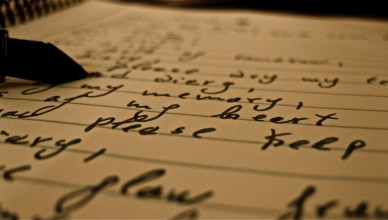
It hides among shadows beneath her bed

With shoestring wrapped around to keep it closed.

I quickly read my name in streaks of blue

Across a page of cluttered memories.

My conscience, strong and able, chose to let

This bold intrusion slide with doubtful eyes.

The me who lives inside this private book,

Would never snoop, or even drink a beer.  


John D. Lippincott currently studies at Berklee and is a student editor of FUSION.


Tags: